

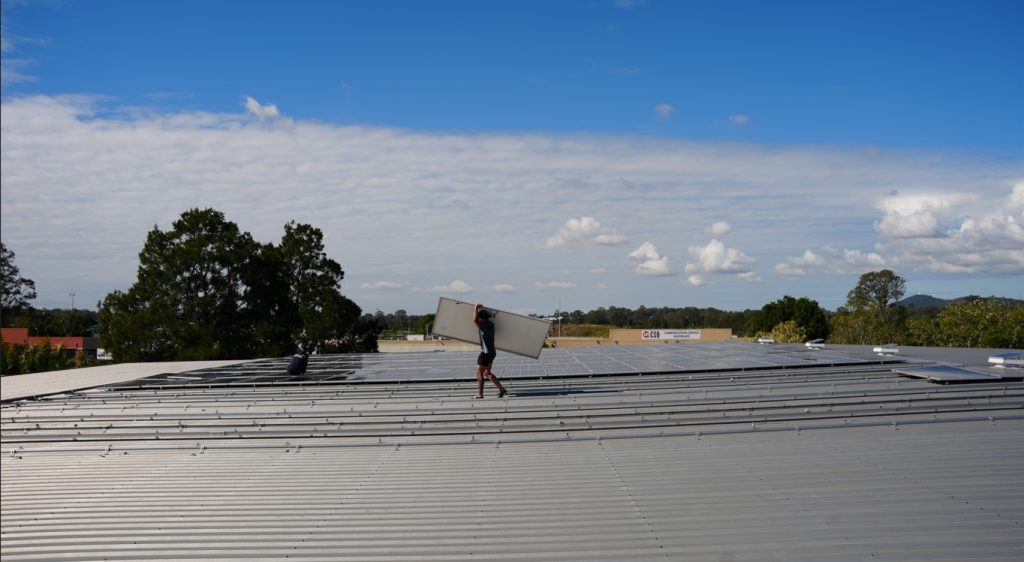
Installing solar creates an asset.
Sustained performance delivers the return.
Commercial solar represents a significant upfront capital investment that converts a portion of recurring electricity expenditure into owned, energy-producing infrastructure.
The asset is created at installation, but its financial value is realised progressively — through every kilowatt-hour it produces, every dollar of grid electricity it displaces and every year it continues to perform.
In financial terms, a performing solar asset can:
reduce operating costs → improve operating margin and cash flow → reduce exposure to future electricity prices → strengthen the return on invested capital
The opportunity, therefore, is not simply to install solar. It is to ensure the asset continues to deliver the value it was purchased to create.
A significant financial asset
Australian Government examples illustrate the scale of the financial value commercial solar can generate:
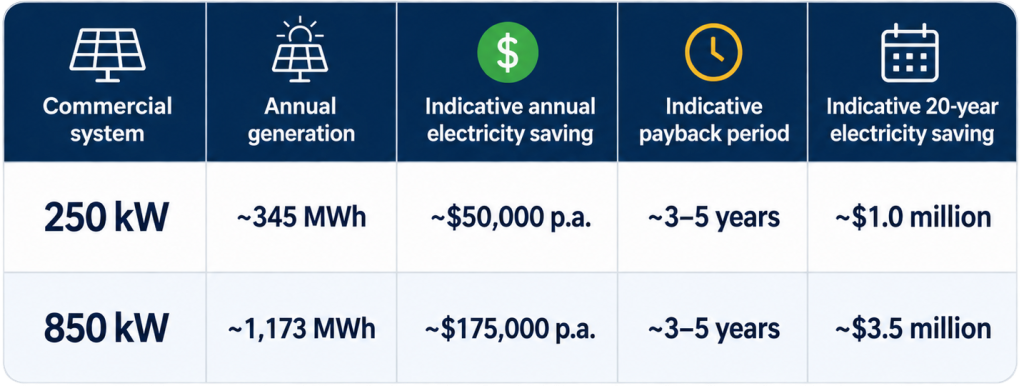
The scale becomes even clearer when performance is translated into financial value.
For an 850 kW asset capable of delivering approximately $175,000 in annual electricity savings:
5% underperformance → ~$8,750 unrealised value per year
10% underperformance → ~$17,500 unrealised value per year
20% underperformance → ~$35,000 unrealised value per year
Over the life of the asset, even relatively small periods of sustained underperformance can materially affect the return the original investment was intended to deliver.
A business may approve a solar investment on the basis of:
Capital investment → short payback period → decades of productive asset life
The commercial opportunity after installation is to know whether that investment continues to perform against that expectation.
The value is created every day
A solar system does not need to fail completely for value to be lost.
An asset may remain operational while experiencing reduced generation, degraded components, monitoring failures, unresolved defects or emerging risks that progressively diminish its performance.
That makes the distinction between operational and healthy important.
A high-performing commercial solar asset can contribute to:
- Reduced electricity operating expenditure
- Improved operating cash flow
- Reduced exposure to grid electricity costs
- Improved return on invested capital
- Reduced grid energy consumption
- Reduced operational emissions
The question after installation should therefore extend beyond:
“Is the solar system working?”
to:
“How healthy is this asset, what is it delivering, and how confidently can we expect that value to continue?”
Performance also matters beyond electricity cost
For property owners and organisations using NABERS Energy, onsite solar can contribute directly to building energy performance by reducing electricity drawn from the grid.
NABERS Energy uses actual operational energy consumption to measure and compare building performance, while the NABERS Renewable Energy Indicator provides visibility of renewable energy contribution, including eligible onsite generation.
For organisations operating against NABERS objectives, emissions-reduction strategies, ESG commitments or portfolio energy targets, the performance of a commercial solar asset can therefore influence more than energy cost alone.
Reduced solar performance may contribute to:
- Higher grid electricity consumption
- Higher operating expenditure
- Lower renewable energy contribution
- Higher operational emissions
- Reduced progress against energy and sustainability objectives
This places solar performance within the broader context of asset performance, financial performance, risk and organisational sustainability outcomes.
Introducing Lifecycle Commercial Solar Asset Management (CSAM™)
Lifecycle Electrical’s proprietary methodology.
Despite the financial value represented by commercial solar, there is currently no widely adopted, standardised way to describe the overall health of a commercial solar asset.
Different contractors may inspect different elements, apply different thresholds and report findings in different ways.
One provider may describe a system as satisfactory while another identifies significant concerns — not necessarily because the asset has changed, but because they are measuring and interpreting different things.
For an organisation managing one solar system, this can make asset health difficult to understand.
Across a portfolio, the problem becomes much larger.
Without a consistent methodology, it can be difficult to:
- Compare one solar asset with another
- Identify which sites require attention first
- Distinguish isolated defects from broader asset risk
- Understand performance in the context of physical condition
- Prioritise maintenance and capital expenditure
- Establish a reliable portfolio-wide view of asset health
Lifecycle Commercial Solar Asset Management (CSAM™) was developed to address this gap.
CSAM is a structured asset management methodology designed to create a consistent way to assess, measure and communicate the health of commercial solar assets throughout their operating life.
Rather than viewing inspection, condition, performance, monitoring and risk as separate activities, CSAM brings them together into one repeatable framework.
The result is structured, evidence-based asset intelligence that can be understood not only by technicians, but by the people responsible for managing the asset, its financial return and the broader property portfolio.
From technical information to a measurable asset
At the centre of the methodology is the CSAM™ Asset Health Score.
The Asset Health Score is designed to bring together multiple indicators of asset health — including:
condition | safety | performance | monitoring status | identified risk | outstanding actions
— into one meaningful measure, while retaining the detailed technical evidence underneath it.
The purpose is not to replace technical reporting.
It is to make that technical information consistent, comparable and actionable.
In the same way that established rating systems can provide organisations with a common reference point for understanding building performance, the ambition of CSAM is to establish a common reference point for understanding commercial solar asset health.
This creates the potential for an asset owner to move from:
“We have solar at this site.”
to:
“We know the health of this asset, how it is performing, what requires attention and how it compares with the rest of our portfolio.”
Changing how commercial solar is managed
CSAM goes beyond improving solar maintenance.
It is designed to change how commercial solar assets are thought about, measured, managed and prioritised.
The traditional approach is often contractor-led and reactive: systems are installed, faults are addressed when they become visible, and individual inspections produce isolated reports at particular points in time.
CSAM establishes a different model:
Structured | Consistent | Evidence-Based | Transparent | Actionable | Enduring
These principles are applied across inspection, assessment, performance review, monitoring and ongoing technical oversight to build a consistent record of asset health over time.
That creates a foundation for better:
maintenance prioritisation → risk management → capital planning → performance oversight → portfolio-level decision making
A common language for solar asset health
The long-term ambition is for the CSAM™ Asset Health Score to carry meaning regardless of who installed the system, what technology it uses or where the asset is located.
A consistent methodology creates the ability to benchmark assets across sites and over time.
For an organisation managing multiple commercial solar systems, that means moving beyond a collection of disconnected systems and technical reports toward a portfolio of measurable business assets.
Ultimately, CSAM is seeking to establish a clear and consistent answer to a question the commercial solar industry currently has no common way of answering:
What does a healthy commercial solar asset look like — and how do we measure it consistently?
That is the role of CSAM.
Not simply to maintain solar systems, but to establish a structured way to define, measure and communicate asset health, so the value created at installation can continue to be understood, protected and realised throughout the asset’s lifecycle.
Installing solar creates an asset. Sustained performance delivers the return.